

Hela supports mixing local split-screen with online play in the same session, which is a configuration most co-op games do not offer. The common pattern is a choice — either everyone is in the room or everyone is on a headset — and the choice usually decides who gets left out.
Windup's answer is the more generous one: two people can share a screen and a console while two more join from elsewhere, and the group still counts as four.
The rule in one table
| Constraint | Value |
|---|---|
| Local players per device | Two |
| Players in a session | Four |
| Mixing local and online | Supported |
| Crossplay between platforms | Not announced |
The first two are the numbers that decide a plan. The fourth is the one that can ruin one, and it is a separate question from mixing — see below.
The example the developers give
The clearest illustration is two plus two: you and a friend on one console, playing split-screen, joined by two other players online. That is a single session of four, with half the group in the room.
The value of that arrangement is social rather than technical. It means a couple can host, and two friends elsewhere can join, without anyone needing a second television or a second copy of the game on the same platform.
Other combinations that fit the rules
With a two-local maximum per device and a four-player ceiling, several arrangements work. One local player plus three online is the ordinary case. Two local plus one online is a three-player session, which the game supports because every puzzle is built for two, three or four participants.
Two devices with two local players each is also four, and it is the arrangement a household with two consoles would reach for. It behaves like a normal online session from the game's point of view.
What does not fit is three people around one screen. The per-device limit is two, so a third person in the room needs a second device rather than a third controller.
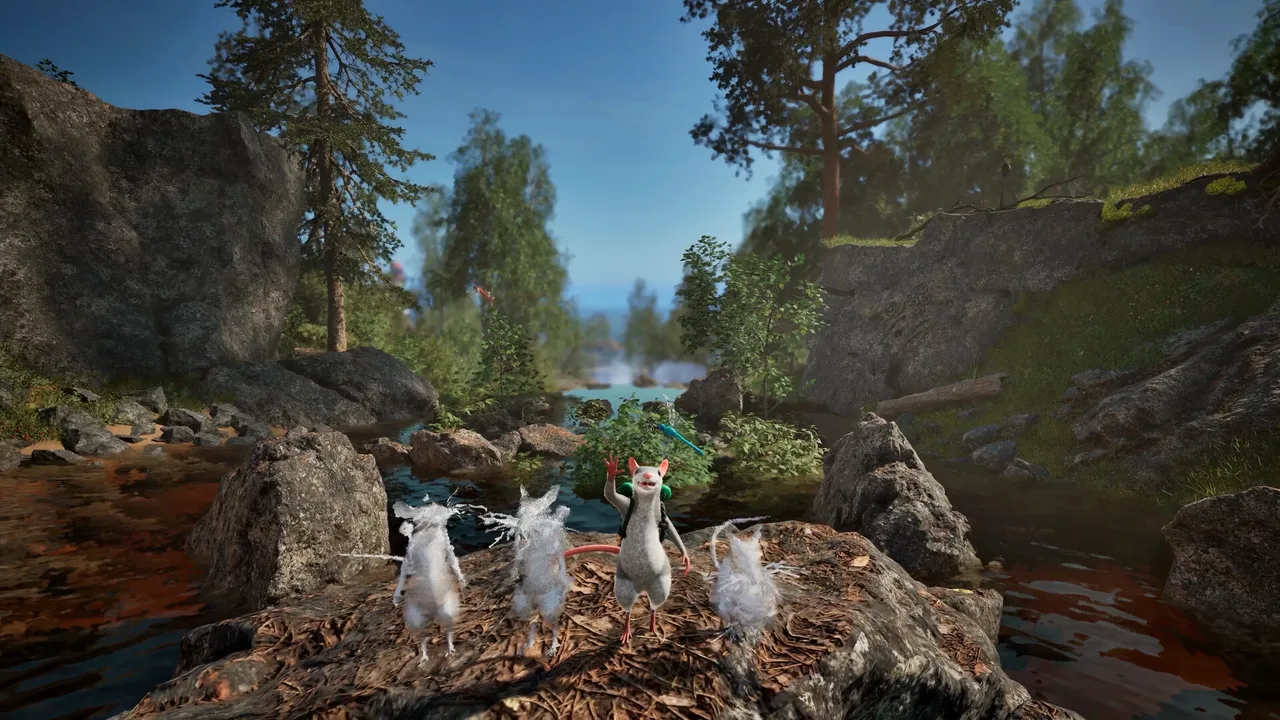 Official media
Let the local pair set the order
The practical sequence for a mixed group is the reverse of what most people try. Get the two local players in first, confirm the split-screen view, then invite the remote half.
Doing it the other way round creates a specific annoyance: the online players start exploring while the couch pair is still in a menu, and by the time everyone is in the session the group is already spread across the map. Hela's calm pace makes that less costly than it would be in an action game, but it still wastes the part of a session where everyone is looking at the same thing.
The reason the order matters at all is the join rule. A local second player cannot drop in after the run has started, so the couch half has to be complete before the session exists.
Why mixing is worth asking for
Plenty of co-op games support four players online and two players locally, and then treat those as separate modes. Mixing them is an extra engineering problem: the session has to reconcile a shared screen with remote clients, and the camera has to serve both.
For a game built on puzzles rather than action, the payoff is larger than usual. Hela's rooms are designed for a specific number of participants, and a group that can assemble four people across two locations gets the full version of those rooms without anyone travelling.
The demo does not do this
The demo supports solo play and two-player local split-screen only. Online co-op is not part of it, so the mixing described above cannot be tested before launch.
That is worth knowing before a group plans around the demo. A couch session is available until 9 November 2026, and it is the right way to check the split-screen view, the second-controller setup and the pace. The online half waits for 1 December 2026.
Crossplay is a different question
Mixing local and online is about where players sit. Crossplay is about which machines they use, and the two are not the same promise.
Hela launches on PC, PlayStation 5, Xbox Series X|S and Nintendo Switch 2. Whether a Steam player can join a PlayStation 5 session has not been announced, and no plan should be built on the assumption that it works. The safe reading is that mixing is confirmed within a platform family, and crossplay is an open question.
Setting up a mixed session
The one rule that catches people out is that the local second player has to join before the session begins. Hela does not accept a drop-in halfway through, so both pads need to be connected and both players present at the start.
For a mixed group, that means the online players should be invited after the local pair is set. Doing it in the other order tends to leave the couch half waiting while the remote half explores.
When the group is smaller than the room
The Shade System is the reason group size never blocks progress. Solo players can create magical copies of themselves to fill roles a puzzle expects, and the copies repeat the action they were performing when created.
That makes a two-person session with two online friends a convenience rather than a requirement. A pair can play the same content, and a solo player can play it too, without the map changing shape.
What to plan for on launch night
Four seats, two of them potentially on one screen, one copy per platform family, and a start order that brings the couch pair in first. That is the whole configuration.
The rest is the game's own advice: no need to rush. Hela has no combat and nothing that can kill a player, so a session's only real failure mode is spending the first twenty minutes in menus.