

Hela: of Mice & Magic plays with up to four people online and up to two people on one screen. The two setups are separate configurations with separate requirements, and the choice between them decides almost everything about how a session starts. Online play runs on Epic Online Services and asks every participant for a third-party account linked to Steam. Local split-screen asks for nothing beyond a second controller and a second person in the room.
The demo complicates the answer, because it carries split-screen only. Online co-op arrives with the retail build on 1 December 2026.
Co-op here means shared exploration, not shared combat
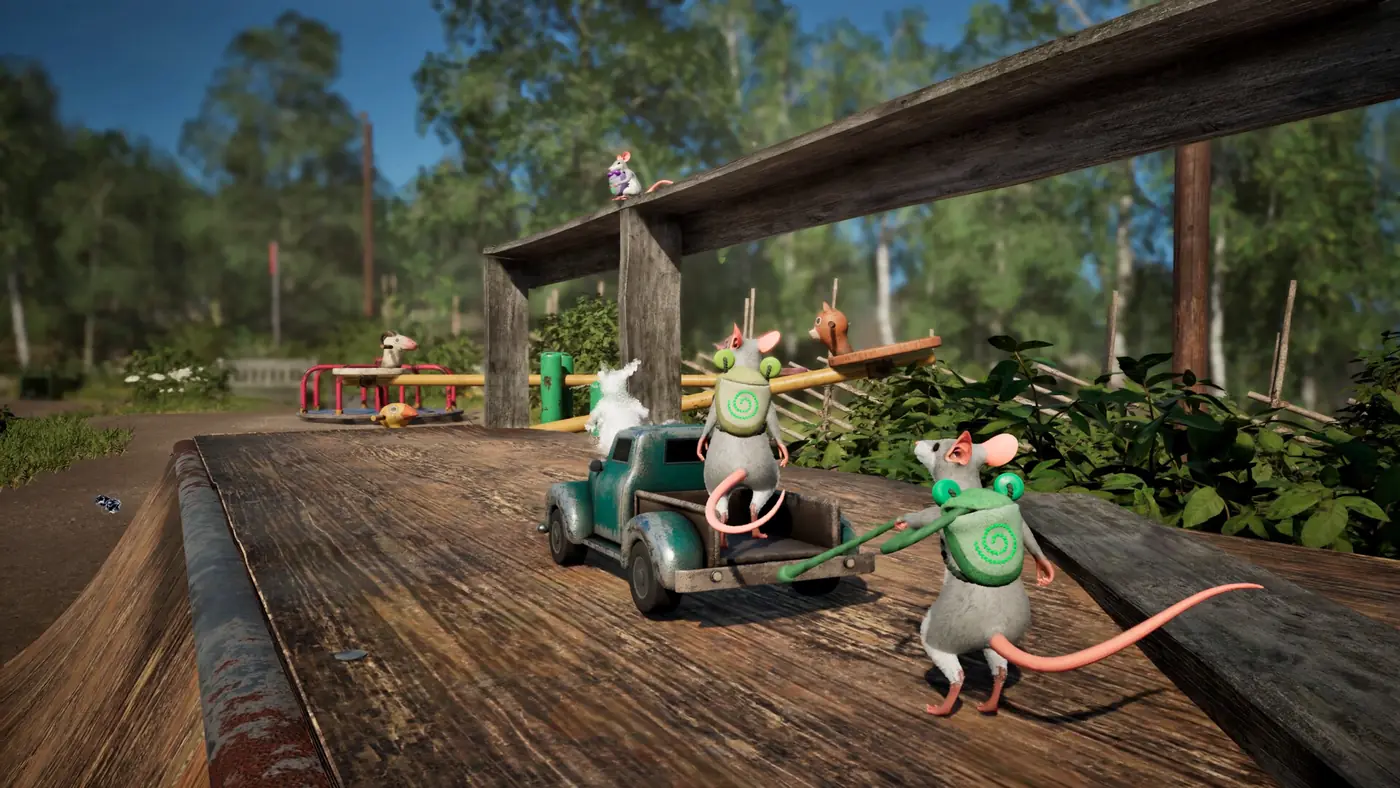
Nothing in the game fights back. There are no enemies, no health bar and no failure state built on taking damage, so co-op is not a combat mode with a second player bolted onto it. A session is spent on the same loop whether one person or four are present: gathering plants and materials, brewing remedies, solving physics puzzles, and helping the creatures along the way.
That shape changes how a group behaves. A second player is not a damage dealer or a tank; they are another pair of paws for a puzzle that expects more than one. The world is a third-person open adventure across forest, meadow, wetland and cave, drawn from northern Sweden and framed at mouse scale, and everyone in the session walks the same ground.
The Shade System, which conjures a magical copy of your mouse, is what makes a solo run hold the same content. In a shared session that copy becomes unnecessary, because a second person occupies the position it would have taken. The puzzles do not change shape; the second body arrives as another player instead of a summon.
Online: four seats, one account each
Online sessions hold four players. The connection layer is Epic Online Services, and the Steam page states plainly that a third-party account is required and has to be linked to Steam. Budget a few minutes for that link before the first session rather than during it, because a group that starts late on a launch night tends to abandon the attempt rather than troubleshoot it.
There is no Friend Pass. Four players means four copies of the game, and nobody joins as a guest on someone else's licence. That detail decides how a group of four splits the cost, and it is better settled a week early than in the lobby.
Online co-op is not in the demo at all. The demo does local split-screen and nothing else, so a group spread across four cities cannot rehearse together before release, and cannot use the demo to test whether the connection holds up.
Split-screen: two people, one display
Local play caps at two players, and the cap matches the per-screen figure the game quotes: two per screen at most. Two controllers, one display, no account and no connection.
The demo adds a quirk that catches people out. The second player has to join before the session begins; there is no drop-in halfway through a run. Plan the couch session from the start rather than expecting a late arrival to slide in after the first puzzle.
Full controller support and a gamepad recommendation both appear in the Steam feature list, which is the practical detail for a shared screen: two pads, two players, and no keyboard split down the middle.
Which setup fits which plan
| Setup | What it needs | On 1 December 2026 | In the demo |
|---|---|---|---|
| Same room, one display | Two controllers; second player joins before the session starts | Yes, up to 2 players | Yes, split-screen only |
| Online, same platform | A copy each; Epic account linked to Steam | Yes, up to 4 players | No |
| Online, different platforms | Crossplay has not been announced | Not announced | No |
| Solo | Nothing beyond the game itself | Yes, full campaign | Yes |
 Official media
The demo will not carry over
The demo is a self-contained story on a map of its own rather than a slice of the campaign, and it runs 30 to 60 minutes. Progress does not carry into the retail game. Treat it as a way to test the feel of a shared screen, how the two views sit on a display and whether a second pad is comfortable, rather than as the opening of a save file.
It closes on 9 November 2026 and runs on Steam, Epic Games Store and the Xbox PC App, with full Steam Deck support. A couch session started in the final week does not need to be finished in one sitting, but it does need to be finished before the demo goes away.
Crossplay is the open question
Crossplay has not been announced. The platforms are set, with digital release on PC through Steam, Epic Games Store and the Xbox PC App, plus PlayStation 5, Xbox Series X|S and Nintendo Switch 2. Whether a Steam player and a PlayStation 5 player can share a session has not been stated, and no arrangement should be planned around it.
For a group that spans platforms, that single unknown is worth waiting on before deciding where to buy. A four-player group that buys on one storefront has no such problem, which is the safer assumption to build a plan on.
Setting up a first session
Decide the shape of the group first: two in one room, or four across four connections. Link the Epic account to Steam ahead of time, confirm everyone owns a copy if the plan is four, and fix a start time rather than a start window.
For a couch, book the second player for the beginning of the session, not the middle, because the demo will not accept them later. Then play the demo if the timing works, since half an hour of shared screen answers questions about the view that no description can settle.
What four players changes in practice
Very little about difficulty, because the game has no combat and nothing that can kill a player. A larger group does not raise the threat; it divides the same tasks across more hands, which suits puzzles built around two or more participants. The map, the objectives and the remedy loop stay identical.
The honest expectation is a different pace rather than a different challenge. With four, conversation does more of the work, and the mouse at the back of the group is usually the one who notices what the others walked past.