
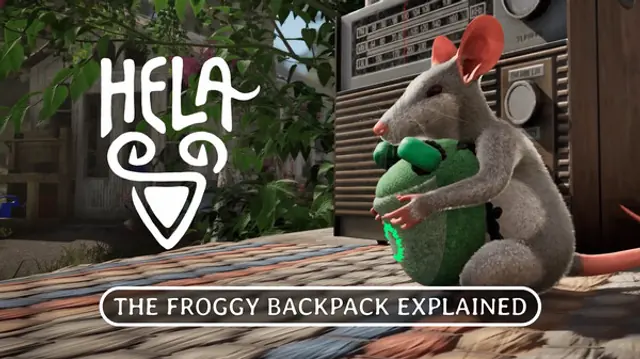
Hela gives the player exactly one piece of equipment, and everything the mouse can do comes out of it. The Froggy backpack glides, swings, pulls and plunges objects, nudges the world, and creates the Shade copies that the puzzle design depends on. There is no second tool, no upgrade tree, and no inventory of gadgets to rotate.
That is a deliberate restriction rather than a small feature set. When one object carries every verb, learning the object is the same thing as learning the game, and a player who knows the five jobs can read a new room before touching it.
A small vessel for a small piece of magic
The backpack's origin is part of the story rather than a menu entry. The Kind Witch shares a little of her own magic with the smallest of her companions, and the frog is the vessel that holds it — a small container for a small piece of power, which is why the tool scales with a mouse rather than with a hero.
The narrative framing matters for how the game plays. The backpack is not loot and it is not earned. It arrives with the character, and the whole adventure is built on the assumption that the player has it from the first minute.
The five things it does
The official description lists them in one sentence, and the order is worth keeping: glide across open spaces, swing between branches, pull and plunge objects, nudge the world in playful ways, and create Shades.
| Job | Input shape | Obstacle it answers |
|---|---|---|
| Glide | Hold and steer through open air | Gaps wider than a jump, drops from height |
| Swing | Attach and release at the arc | Routes that hang above the ground |
| Pull and plunge | Grip and move an object | Weights, plugs, platforms on rails |
| Nudge | Push, tip, roll | Physics props that need rearranging |
| Create Shades | Summon a copy | Anywhere a second body must stay put |
Read as a set, the five cover movement, manipulation and substitution. Almost no room in the demo asks for anything outside that list, which is why the game can keep adding obstacles without adding abilities.
Glide across open spaces
Gliding is the widest-use verb and the one that changes how the map reads. A gap that looks like a boundary is often a glide route, and height stops being a hazard once the descent is free.
The useful habit is to look up before looking across. Most of the demo's open areas have a high line and a low line, and the high one is usually the shorter route. A player who stays on the ground reads the same space as a maze.
Swing between branches
Swinging turns a hanging point into a road. Where gliding crosses a gap in a straight line, swinging converts a vertical drop into forward travel, and it is the answer whenever a route disappears into the canopy.
The two verbs are easy to confuse at first because both move the mouse through air. The distinction is the anchor: a glide needs open space and a launch height, a swing needs something above to attach to. Naming which one a room offers is most of the puzzle.
Pull and plunge objects
This is the manipulation pair: pulling something toward you and plunging it into place. In practice it covers weights, plugs, and the kind of platform that only moves while something is being dragged.
Physical puzzles in Hela are built on mass and leverage rather than on switches, so the answer is usually about where an object ends up rather than which button is pressed. A crate that can be pulled is a tool, not scenery.
 Official media
Nudge the world in playful ways
The last non-Shade verb is the loosest, and it is where the game's physics toy shows through. Rolling, tipping and pushing props is rarely required and almost always rewarded, and the demo's optional discoveries tend to sit behind something that could be moved.
This is also the verb that makes the world feel bigger than its map. A room that can be rearranged is a room with more than one solution, and the game does not punish the slower answer.
The backpack is also where Shades come from
One detail worth noticing: creating a Shade is listed as a backpack function rather than as a separate power. The copy is not a spell the mouse knows, it is another thing the frog does.
That matters for how the systems fit together. There is one tool, and the social layer of the game — filling roles when fewer players are present — sits inside the same device as movement and manipulation. Nothing in Hela is bolted on.
Why one tool covers all of it
A single-tool design forces the level designers to reuse a small vocabulary, and reuse is what makes a game readable. After an hour, a player stops seeing a branch, a puddle and a root as three objects and starts seeing a bridge, a lake and a cliff — the same three verbs in new clothes.
The trade is that nothing surprises you twice. Once the five jobs are learned, a new area is a new arrangement rather than a new rule. For a calm exploration game that is the right trade, because the interest is meant to come from the arrangement.
Learning it in the demo
The demo is a self-contained story with a map of its own, and it runs between thirty and sixty minutes depending on how much of it you poke at. Progress does not carry into the retail game, so the time is best spent on the verbs rather than on finishing.
Practise all five on safe ground first. There are no enemies and nothing that can damage the mouse, so the only cost of experimenting is a short walk back, and the walk back is usually where the missed route becomes visible.
The demo closes on 9 November 2026. It supports solo play and two-player local split-screen, with online co-op reserved for the full game when it launches on 1 December 2026.
- 1
Glide first
Learn the height-to-distance feel before anything else.
- 2
Then swing
Find a branch and feel how the arc differs from a glide.
- 3
Then drag something
Pulling is slow and precise; it teaches patience.
- 4
Then summon a Shade
The copy inherits whatever you were doing.
What the backpack will not do
It will not fight. Hela has no traditional combat and nothing that can kill a player, so the frog never becomes a weapon and never needs upgrading for a harder enemy. Anyone waiting for a combat layer is waiting for something the game does not have.
It also will not store the things you collect. Brewing happens at the cottage, not in the bag, which is why the gathering loop keeps pulling the player home rather than letting a run continue indefinitely.