

Crossplay between platforms has not been announced for Hela: of Mice & Magic. Online co-op supports 4 players, the game launches on PC, PS5, Xbox Series X|S and Switch 2 on 1 December 2026, and nothing published says whether a player on one of those platforms can join a session hosted on another.
What is actually known
Online co-op runs through Epic Online Services and asks for a third-party account linked to Steam. The ceiling is 4 players online, and local split-screen supports 2 players with a maximum of 2 per screen.
Those are three separate facts with three separate scopes. The player ceiling describes how many people fit in a session. The account requirement describes what a player signs into before joining. Neither describes which platforms can meet, and that third question has no answer in the announcement.
The absence of an answer is not the same as a no. It is also not a yes. A player planning to buy on PS5 in order to play with a friend on Steam is planning around something nobody has promised.
 Official media · Steam
Four platforms on one day is not crossplay
Every version releases on 1 December 2026, and that is a statement about the calendar. It does not imply a shared player pool, shared servers or a shared friends list.
The distinction is easy to lose in a launch week, because a simultaneous release is usually a good sign for crossplay and often accompanies it. Here the release is simultaneous and the networking question is open, which means the two facts have to be held separately until something addresses the second one.
Four online players means four copies
There is no Friend Pass. The game has no mechanism for inviting someone who does not own a copy, so a four-player online session requires four purchases, or four people whose access comes from elsewhere.
That "elsewhere" is Xbox Game Pass, which covers Xbox Series X|S and PC from day one. A subscriber on Xbox and a subscriber on the Xbox PC app both have access without buying, which is a way to reach four players without four purchases, provided all four sit inside that subscription.
On PS5 and Switch 2 there is no subscription route, so four players there means four copies of the game.
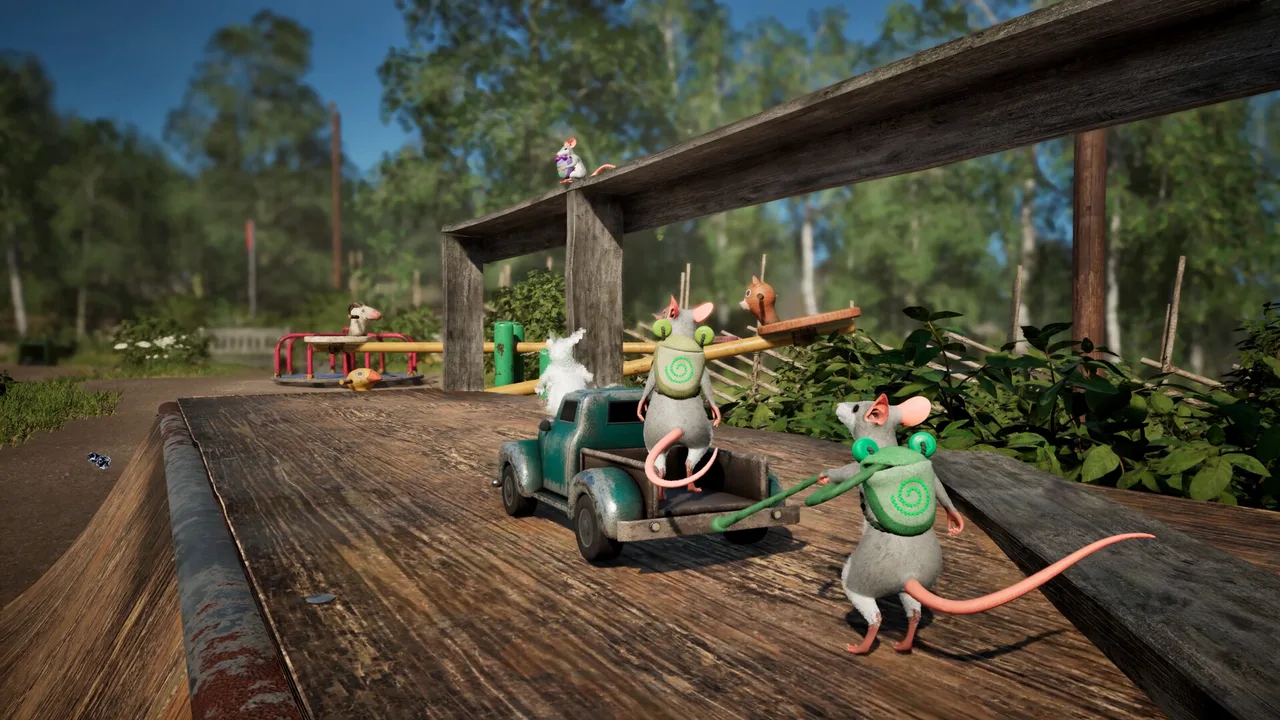 Official media · Steam
Remote Play Together is not crossplay
Steam lists Remote Play Together, and it is the feature most likely to be mistaken for crossplay. It is not.
Remote Play Together streams a local session to a second person over the network. The host runs the game, the guest sees the host's screen and sends input back. It extends a local split-screen mode across distance, and it is bound to the two-player local ceiling rather than to the four-player online ceiling.
Crossplay, by contrast, would put a PS5 player and a Steam player into the same online lobby as separate clients on separate machines. Remote Play Together does not do that. It does not add a third or fourth player either, and it does not cross a platform boundary.
Three practical differences follow. Remote Play Together needs a host who owns the game and stays in the session. It runs at the quality the stream allows rather than at native rendering. And it inherits the local split-screen limit of 2 players, which is half of what online co-op offers.
A group of four in different cities is therefore looking at online co-op rather than at streaming, and the platform question returns the moment that group forms. Streaming solves distance for one guest; it does not solve a mixed platform for three.
Same screen, same platform, same lobby
| Scenario | Works |
|---|---|
| 4 players online, all on the same platform | Yes |
| 2 players on one screen, one copy | Yes |
| 2 players on one screen, each with their own copy | Yes |
| 4 players across PS5, Xbox, Switch 2 and PC | Not announced |
| 2 players, one copy, two locations | Yes, through Remote Play Together on Steam |
| 2 players, one copy, two locations, console to console | No equivalent listed |
| Single player, no second person | Yes, via the Shade System |
The table is short because the game's multiplayer model is short: one online ceiling of 4, one local ceiling of 2, and a streaming feature that reuses the local ceiling rather than extending the online one.
What a session looks like in practice
A four-player group on the same platform is the case the announcement actually supports. Four people, four copies, one lobby, all through Epic Online Services.
A mixed group is the case nobody can plan for yet. A PS5 owner with three friends on Steam, or an Xbox owner with two on Switch 2, has no published answer about whether those friends can be in the same session. The honest planning assumption is that they cannot be assumed to meet, and that the four-player ceiling applies within a platform until something says otherwise.
A two-player household is the simplest case and the one most fully documented: one screen, two players, a maximum of 2 per screen, and single-player always available as a fallback because the Shade System covers the co-op puzzles alone.
The demo that preceded launch had no online play at all, offering one player and 2-player local split-screen only. Nobody who played it has seen the online layer in action, which leaves the 4-player mode arriving untested on 1 December 2026 alongside the question of who can meet whom inside it.
Whatever happens with crossplay, the single-player route is complete. The Shade System summons a magical double of the player character, letting puzzles built around two bodies be solved by one, so nobody is locked out of finishing the game by a networking decision. A mixed-platform group that cannot meet online still has four separate complete games available to it.
What would settle it
One sentence from the publisher would. Until then the position is unchanged: 4 players online, 2 players local, Epic Online Services with a linked third-party account, four platforms on 1 December 2026, and no published statement about whether they meet in the same lobby.
Everything else about the release is settled. This one item is not, and treating it as settled in either direction is a guess.