
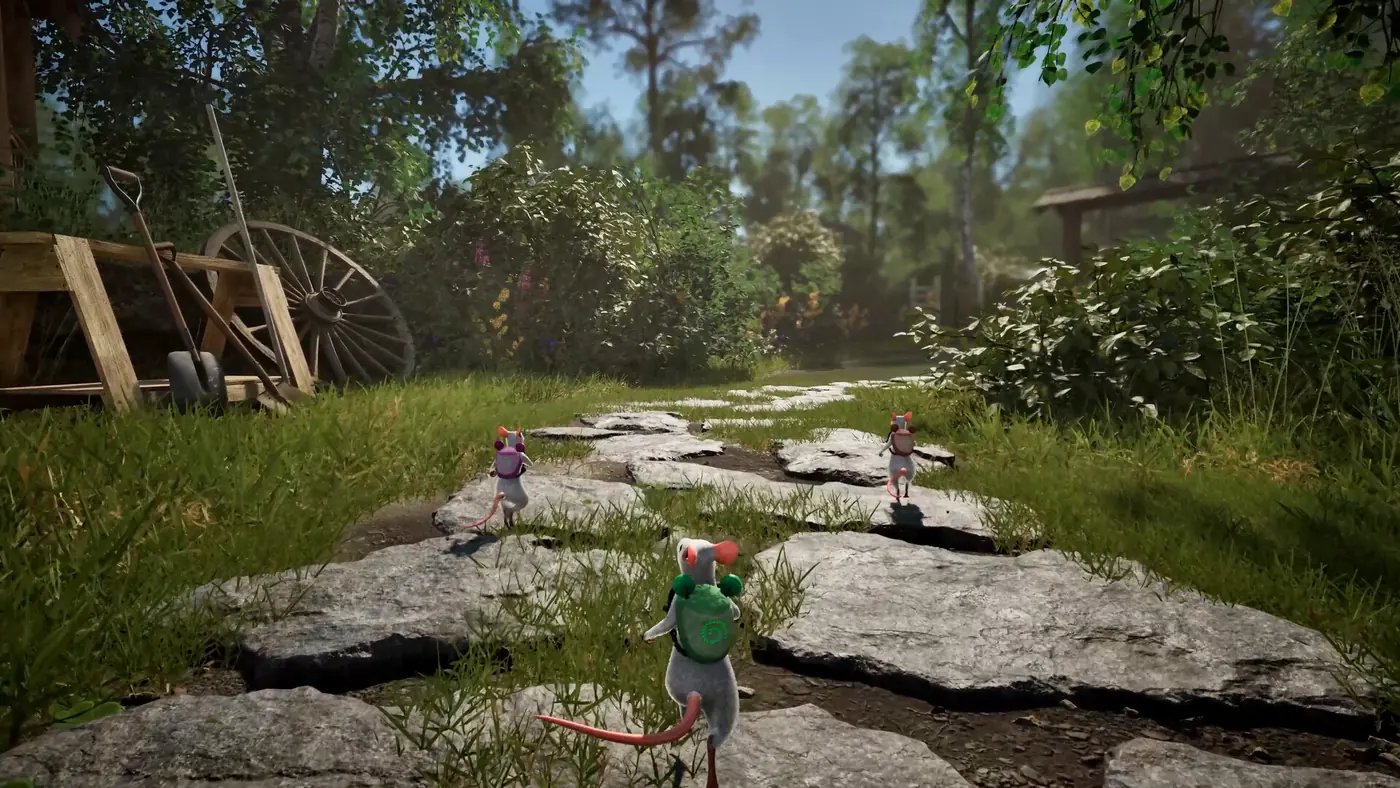
Hela: of Mice & Magic supports one player alone, two players in local split-screen, and up to four players online. The count changes who is holding a controller, not how much of the game exists. Every configuration reaches the same map, the same objective chain and the same loop of gathering, brewing remedies and solving physics puzzles.
What does change is how the work divides. The game has no combat, no enemies and no health bar, so a bigger group does not add threat. It adds hands.
The configurations at a glance
| Configuration | How it works | Content |
|---|---|---|
| One player | Shade System supplies the second pair of paws | Full campaign |
| Two on one screen | Local split-screen, two per screen at most | Full campaign |
| Two online | Epic Online Services, one copy each | Full campaign |
| Three or four online | Same online mode, four seats | Full campaign |
| Two, mixed platforms | Crossplay has not been announced | Not announced |
 Official media · Steam
Three players have one route
Three is the count with no convenient answer. The only way to seat three is online, with three copies and three linked accounts, because local play stops at two and there is no way to pair a couch with a remote third player. The online mode holds four, so a group of three plays with one seat empty.
Nothing about the game changes as a result. The same objectives are there, and the same remedies. What changes is the planning: three people cannot share a screen, cannot use the demo together, and cannot lean on a Friend Pass to keep the cost down.
Solo is not a cut-down version
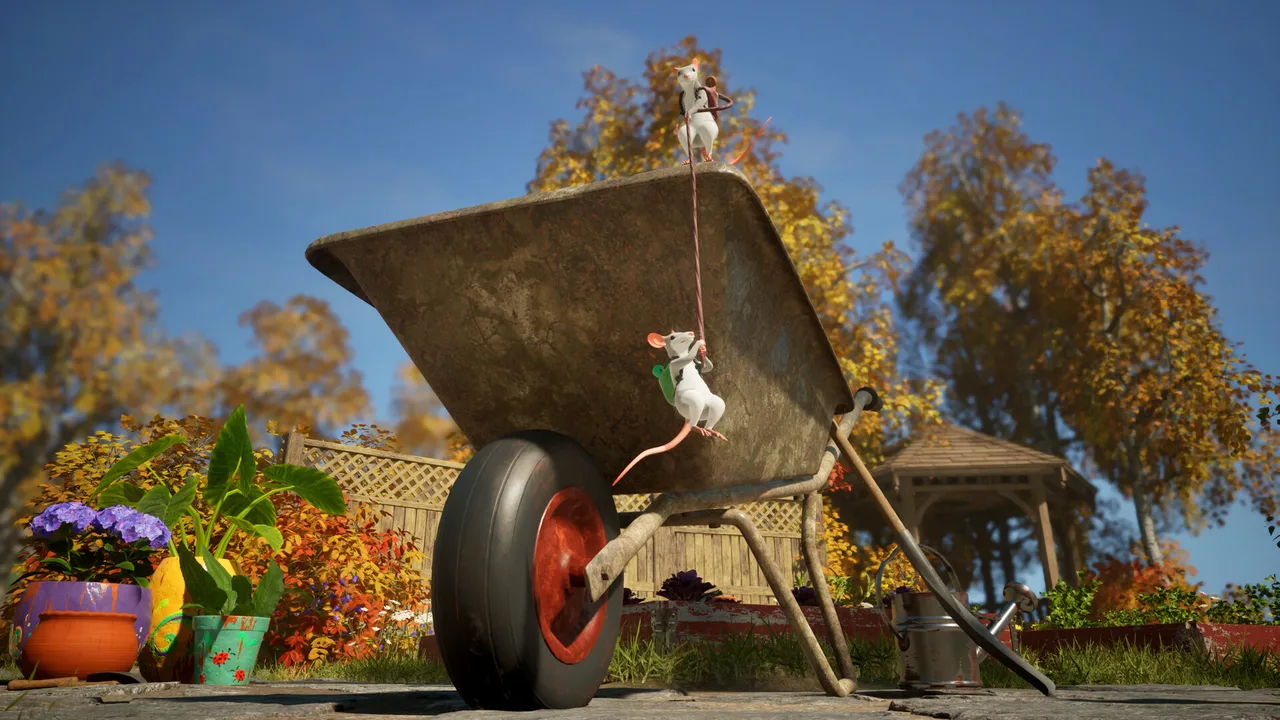
The Shade System exists to keep solo play whole. It summons a magical copy of your mouse, so a puzzle that expects two participants can still be solved by one person acting twice. The campaign runs from start to finish without a second player, and nothing in the objective chain waits on a partner.
The setting supports that: a sick witch, a world that has lost its harmony, and her smallest familiar sent out to keep watch in her place. A lone mouse wandering a forest at mouse scale is the premise, not a compromise.
 Official media · Steam
Four players is more division of labour, not more difficulty
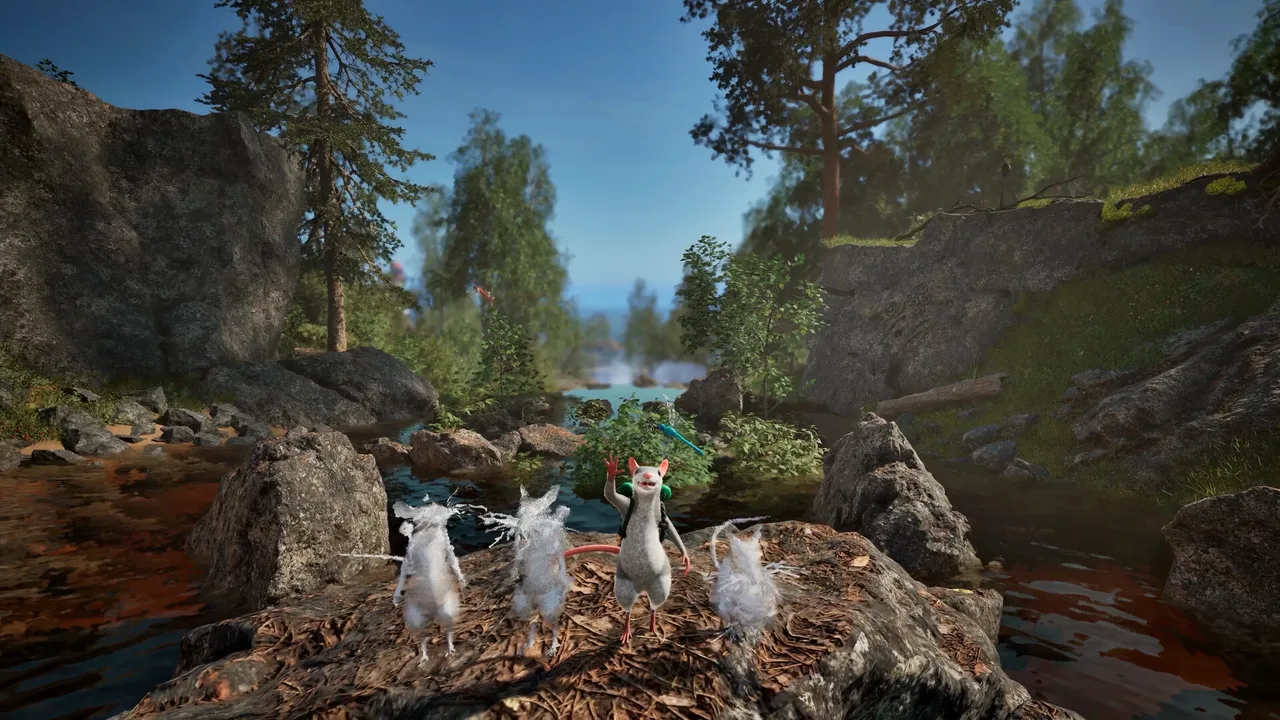
With nothing in the game able to kill a player, a group of four does not face a harder version of the same map. The puzzles, the creatures and the remedies are the ones a solo player meets. The extra people divide the tasks instead of multiplying the obstacles.
Whether that feels easier or merely busier depends on the group. Four players talking through one puzzle will often solve it faster than two, and will just as often spend the same time discussing it. The game does not adjudicate.
Two players, two formats
Two is the most common count, and it arrives in two shapes that behave nothing alike. Local split-screen needs one display, two controllers and no account. Online needs a copy each, a third-party Epic Online Services account linked to Steam, and a connection.
The content is identical either way. The difference is logistical, and it decides which of the two a given pair can actually use.
The demo is a two-player build
The demo supports solo play and two-player local split-screen. Online is absent entirely, so a group of three or four has no way to test the configuration before release. The second player has to join before the session begins rather than dropping in mid-run.
The demo is a self-contained story on its own map, runs 30 to 60 minutes, and does not carry progress into the retail game. It closes on 9 November 2026.
A pair can test the couch route in it and nothing else, so the demo is a fair preview of local play and no preview at all of an online session. A group of four planning to play together on 1 December 2026 is deciding on the description rather than on a trial.
Online tops out at four
Four is the ceiling for online sessions, and it comes with a purchasing condition: there is no Friend Pass, so four players means four copies. The four seats are not a queue that fills from a shared licence.
Reaching four also requires the account link on each machine. That is the step that turns a planned launch-night session into a twenty-minute delay if it is left to the last moment.
What the count does not decide
Player count has no bearing on platforms, price or content. The digital release arrives on 1 December 2026 for PC through Steam, Epic Games Store and the Xbox PC App, plus PlayStation 5, Xbox Series X|S and Nintendo Switch 2, and the day-one Xbox Game Pass entry covers Xbox Series X|S and PC.
Crossplay has not been announced, which is the one question a mixed-platform group cannot answer from the player count alone. A pair on two different platforms may have no route at all, and a group of four on one platform has nothing to worry about.
The count is the same on every platform
The number of seats does not vary by system, but the way a group buys does. Digital release covers PC through Steam, Epic Games Store and the Xbox PC App, plus PlayStation 5, Xbox Series X|S and Nintendo Switch 2, all on 1 December 2026. Xbox Game Pass carries the game on Xbox Series X|S and PC from day one, which is the cheapest route for a group already inside that ecosystem.
The physical Harmony Edition reaches PlayStation 5, Xbox Series X and Nintendo Switch 2 only, so an Xbox Series S owner or a PC player has the digital release and nothing else. Digital pricing has not been published, and Steam offers a wishlist button rather than a pre-order.
Choosing a count
A first run alone is the cleanest way to learn the loop, because the Shade System teaches cooperation by making one player do both halves. A second run with someone else then shows what the puzzles were built around.
For a group of friends, the practical split is two on a couch and four online. Three is the awkward number: too many for split-screen, and a session that always leaves a seat empty online. No configuration fixes that, and the game does not pretend otherwise.